
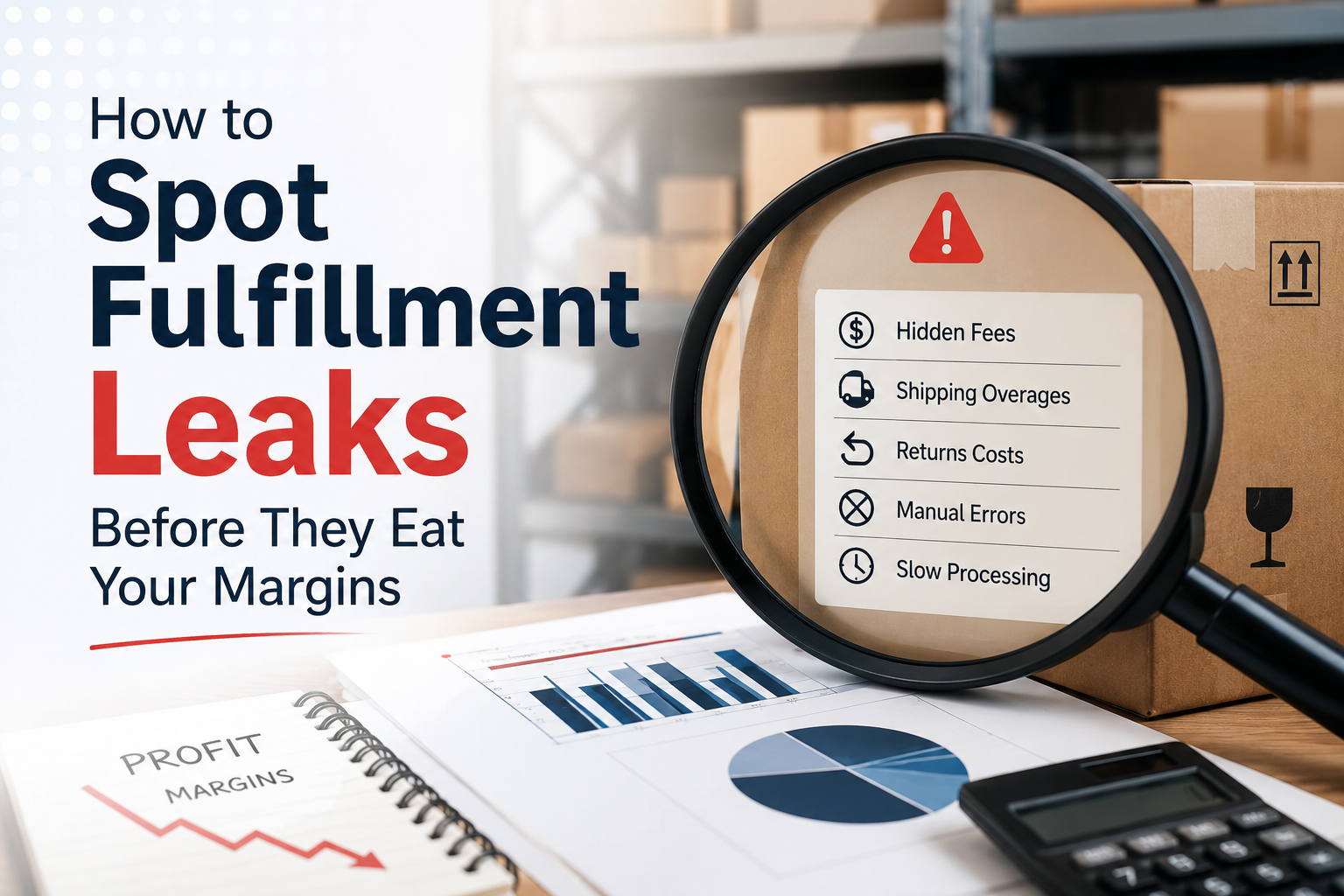
How to Spot Fulfillment Leaks Before They Eat Your Margins (2026 Checklist)
How to Spot Fulfillment Leaks Before They Eat Your Margins matters more than ever in 2026, because ecommerce teams are dealing with faster fee changes, tighter ad costs, and customers who will not wait when delivery slips. If you are not watching fulfillment as closely as marketing and pricing, margin loss can look “normal” until it is already too late, and one small change can make the problem grow quietly.
Key Takeaways
What you track
|
Where leaks hide
|
- Audit your ecommerce fulfillment inputs weekly, not monthly, so fulfillment for ecommerce stays profitable as conditions shift in 2026.
- Use exception-based reporting (late, lost, damaged, reshipped) to find the specific fulfillment leak, not just the symptom.
- Check ecommerce order fulfillment profitability at the SKU level, especially for heavy and low-margin items.
- Confirm your order routing rules match reality, or you will pay for the wrong fulfillment center ecommerce flow.
- Validate your fulfillment fees line items, including surcharges and size-tier impacts that can change per-unit economics.
- If you need a shortcut to stop technical and operational guesswork, we run Done-for-You store setups plus product sourcing and execution that aim to remove the hassle so you can get started as quickly and easily as possible (see our Done-for-You ecommerce Store overview).
Common questions people ask about ecommerce and fulfillment in 2026:
- How do I spot ecommerce fulfillment cost creep? Track per-order fulfillment cost by SKU and shipping method, then compare planned vs actual within the same week.
- What are the biggest fulfillment leaks for ecommerce product fulfillment? Mispriced shipping, inaccurate item dimensions, inventory mismatch, and high return costs that do not show up in basic dashboards.
Silent inefficiencies in retail fulfillment quietly erode revenue before leaders spot them.
1) Start with fulfillment cost math that matches ecommerce reality
If you want to know How to Spot Fulfillment Leaks Before They Eat Your Margins, do not start with vague “profit” charts. Start with the per-order math that actually drives ecommerce order fulfillment margins.
In 2026, “one number” reporting hides too much. Averages blur the truth, and fulfillment companies for ecommerce can deliver very different outcomes depending on SKU size, pick complexity, and shipping method.
Here is the structure we recommend, because it forces the truth to show up:
- Planned fulfillment cost per order (your estimates for picking, packing, shipping, and handling)
- Actual fulfillment cost per order (from your invoices or fulfillment provider statements)
- Variance = actual – planned (in dollars and percent)
- Attribution by channel (Amazon, eBay, Shopify, and any ecommerce fulfillment platform you run)
- Attribution by SKU attributes (weight, dimensions, return risk, and fragility)
Once you can see variance by SKU and shipping method, fulfillment for ecommerce becomes measurable. Then leaks stop being “mystery margins” and become line items you can fix.
2) Watch the “exception list,” not the normal flow
Most teams monitor only “delivered” performance. To learn How to Spot Fulfillment Leaks Before They Eat Your Margins, you need the exception list, because exceptions are where cost explodes.
Make sure your reports include these events, and treat each one like a potential leak:
- Late shipments (customer service tickets, goodwill refunds, and delayed delivery credits)
- Lost or damaged packages (replacement costs and write-offs)
- Reships (new shipping charges, handling, and processing time)
- Partial shipments (split orders and extra pick-and-pack cycles)
- Inventory backorders (late fulfillment, cancellation costs, and reduced conversion)
Then connect each exception category to margin impact. If you are running ecommerce fulfillment services or a fulfillment center ecommerce provider, this is where you can question assumptions and tighten your process.
Picture this: a SKU seems profitable in basic reporting, but it triggers a disproportionate share of partial shipments and reships. That is a fulfillment leak. And it will keep eating your margin until you isolate it by SKU and exception type.
3) Inventory mismatches are fulfillment leaks with a delay timer
In ecommerce and fulfillment, inventory mismatch is rarely “instant.” It usually appears later as partial shipments, late delivery, and a wave of customer support activity.
To spot fulfillment leaks early, validate these inventory relationships in 2026:
- Sales channel inventory (what Shopify, eBay, and Amazon say you have)
- Fulfillment center ecommerce inventory (what your ecommerce 3pl, 3pl ecommerce setup, or fulfillment company for ecommerce actually holds)
- Unshipped orders by aging (orders older than your normal picking window)
- Inbound stock status (in-transit and receiving delays)
When these do not align, you get “phantom availability,” which triggers emergency flows. Emergency flows often mean extra handling, extra shipping, and more returns.
If you are optimizing ecommerce product fulfillment, treat inventory as a margin lever, not a backstage detail. Add a weekly reconciliation that compares channel sell-through to fulfillment reality.
4) Confirm fee line items, especially surcharges and size-tier costs
Many ecommerce fulfillment provider problems show up as “why did our per-order costs rise?” If you want to learn How to Spot Fulfillment Leaks Before They Eat Your Margins, you need to audit the fee line items, not just the invoice total.
In 2026, per-unit economics can shift when fulfillment fees are updated. For example, fuel and inflation surcharge structures and size-tier fee rules can change, and the impact can be measurable at the SKU level, not the overall account level.
Here are the fee categories to verify line-by-line when you run ecommerce fulfillment:
- Pick and pack fees (are they changing by order complexity?)
- Shipping rate logic (zones, carrier choice, and any service-level upgrades)
- Dimension-based pricing (weights and size tiers must match how the box is actually packed)
- Storage and handling (especially for “quiet leaks” like excess safety stock)
- Returns processing (reverse logistics fees and disposition rules)
Once the fee categories are clear, you can run a simple test. Pick your worst-margin SKUs, then compare planned cost vs actual cost. That is where the leak is usually hiding.
5) Shipping and return rules often sabotage your order fulfillment for ecommerce model
Shipping promises and return policies look like customer experience topics, but they directly affect ecommerce order fulfillment costs. If you want How to Spot Fulfillment Leaks Before They Eat Your Margins, treat shipping and returns like fulfillment engineering.
In practice, fulfillment leaks show up through:
- Free shipping thresholds that encourage orders with higher-than-expected weight or packaging needs
- Bundling logic that creates split shipments across different fulfillment center ecommerce locations
- Return reason patterns (damaged in transit, sizing mismatch, or “not as described”)
- Refund timing that delays cash flow, even if product is later restocked
To fix this, connect product pages, packaging assumptions, and fulfillment performance. If you want a technical starting point for product page structure and how items are represented to buyers, review our guide on ecommerce store product pages.
When product expectations match packing reality, returns drop, and fulfillment leaks lose fuel.
6) Choose an ecommerce fulfillment center setup based on cost drivers, not convenience
“Ecommerce fulfillment center near me” sounds appealing, but the real question is what cost drivers you are paying for, not what address is closest.
Different fulfillment center ecommerce strategies change your pick-and-pack cycles, shipping zones, and exception rates. If you are using ecommerce fulfillment services across channels, confirm how your setup handles:
- Peak periods (do you get surges in delays and reships?)
- SKU mix (heavy items and low pick simplicity often cost more)
- Location routing (does the system choose the lowest-cost option, or the fastest one?)
- Inventory distribution (where you store inventory determines partial shipment frequency)
It also matters how the fulfillment companies for ecommerce manage order routing rules. If a system ships from the wrong location, you get extra shipping cost, plus the operational time that can lead to exceptions.
In other words, convenience is not a margin strategy. In 2026, your ecommerce and fulfillment setup should be built around measurable cost drivers.
7) Use a repeatable monthly audit, then tighten weekly
You do not need a fancy program to learn How to Spot Fulfillment Leaks Before They Eat Your Margins. You need a repeatable audit rhythm that turns chaos into a controllable loop.
Start with a monthly audit, then move the fixes you can implement into weekly monitoring.
Here is a practical audit template for ecommerce and fulfillment teams:
- Top 20 SKUs by order count, then sort by fulfillment cost per unit
- Top 20 SKUs by negative margin, then isolate exceptions and return rates
- Compare planned vs actual cost for each exception type
- Review dimension and weight accuracy for the worst offenders
- Check partial shipment rate for bundles and variants
- Confirm fulfillment fee updates that may change per-unit economics
As you explore these solutions, think about how they can alleviate your concerns and pave the way for your entrepreneurial dreams. If you want help building the operational foundation so you do not start with avoidable guesswork, our Done-for-You approach focuses on removing hassle and getting you moving fast, without the usual technical set-ups.
8) When fulfillment leaks show up, act like an operator, not a guesser
Once you identify How to Spot Fulfillment Leaks Before They Eat Your Margins, the next step is executing fixes fast. Most teams lose time because they treat leaks like “marketing issues” or “supplier problems.” They are often fulfillment engineering problems.
Here are operator moves that usually stop leaks quickly:
- Fix packaging inputs: verify SKU weight and dimensions match the packed reality, not the spec sheet.
- Adjust shipping method: if you are losing margin to speed upgrades, confirm which service levels you actually need.
- Reduce split shipments: align bundles and inventory placement so orders ship together more often.
- Tighten return prevention: improve product page accuracy so customers know what they are buying.
- Reprice shipping and handling: if free shipping is pushing expensive orders, update your thresholds.
Her dream of easy money turned into a nightmare of endless headaches. That story repeats whenever teams ignore the operational signals. The fix is to watch ecommerce 3pl performance like a controllable system, not a black box.
If you are considering different fulfillment center ecommerce flows, start by documenting your current order fulfillment for ecommerce costs, then test changes against variance metrics.
Conclusion
How to Spot Fulfillment Leaks Before They Eat Your Margins in 2026 comes down to one discipline: track fulfillment costs the way ecommerce actually runs, then isolate exceptions and fee line items that create margin drift. When you review planned vs actual costs per SKU, validate inventory alignment, and audit shipping and returns like an operator, fulfillment for ecommerce stops quietly draining your profit.
If you want a practical way to reduce early operational guesswork, our Done-for-You ecommerce store approach is designed to help you launch faster, with everything set up so you can get started as quickly and easily as possible. You can reach our team at our contact page if you want to explore a turnkey solution mindset.
Frequently Asked Questions
What are the most common ecommerce fulfillment leaks in 2026?
The most common ecommerce fulfillment leaks are inventory mismatches that cause partial shipments, incorrect dimension or weight inputs that trigger higher shipping charges, and return patterns that quietly raise reverse logistics cost. To spot them, compare planned vs actual fulfillment cost per SKU and isolate exception categories like reships and damaged deliveries.
How do I check ecommerce 3pl or fulfillment company for ecommerce pricing is really hurting margins?
Review the invoice line items by category, then map each line item to the SKU attributes that drive cost, like weight and size tiers. In 2026, even small changes in ecommerce fulfillment fees can have a real impact when multiplied across order volume.
What metrics should we track for fulfillment for ecommerce profitability?
Track per-order fulfillment cost by channel and SKU, exception rates (late, lost, damaged, reshipped), partial shipment rate, and return rate by reason. This creates a clear path for how to spot fulfillment leaks before they eat your margins, instead of relying on average profit dashboards.
Is shopify fulfillment orders data enough to find fulfillment leaks?
Shopify fulfillment orders data is a strong start, but it is not enough if your ecommerce and fulfillment stack includes multiple channels or a separate ecommerce fulfillment center inventory feed. You still need planned vs actual cost and exception-based reporting to catch the leaks that show up outside the “normal” delivered flow.
How can we reduce ecommerce order fulfillment cost without slowing delivery?
Fix the cost drivers first, like packaging inputs, shipping method routing rules, and split-shipment triggers from inventory distribution. Then validate changes using variance metrics so you know you reduced ecommerce product fulfillment costs without increasing late deliveries.
What is the fastest way to spot fulfillment leaks across multiple platforms in 2026?
Use exception-based reporting plus per-order variance by SKU, then run the same audit template across each channel, including online order fulfillment. This helps you spot fulfillment leaks before they eat your margins even when Amazon, eBay, and Shopify fulfillment behave differently.