
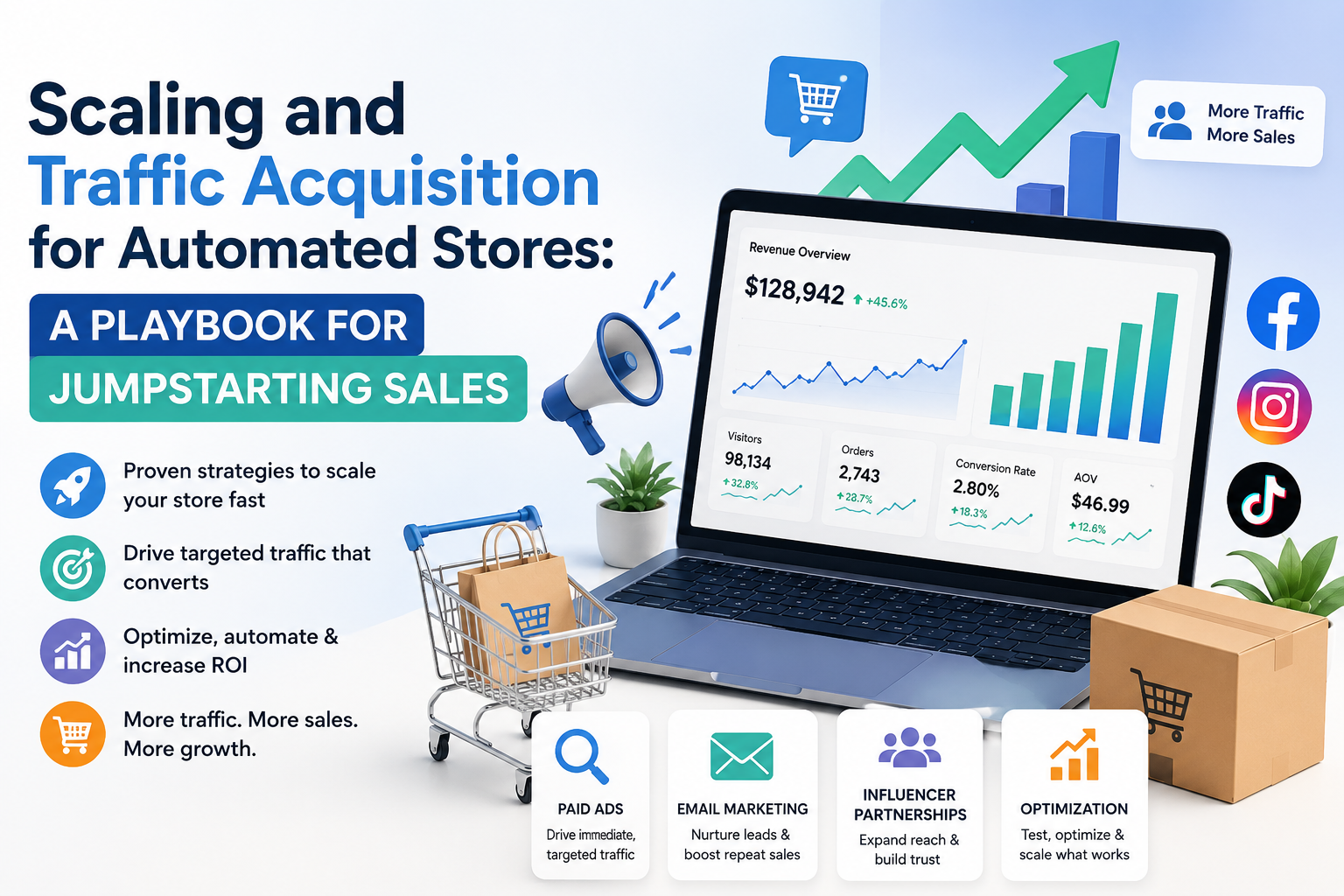
Scaling and Traffic Acquisition for Automated Stores: A 2026 Playbook for Jumpstarting Sales
Scaling and Traffic Acquisition for Automated Stores in 2026 is moving fast, and the numbers prove it, AI-referred traffic has driven 4,700% YoY growth to U.S. retail sites, which means discovery is getting smarter and faster than most store owners can keep up with. The winners are the ones who treat automation like an operating system, not a one-time setup.
Key Takeaways
| 1) Start with speed-to-market | If your store is slow to launch, your traffic strategy starts late. That’s money leaving the table. |
| 2) Use “proven-to-sell” inventory systems | Remove guesswork with automated product catalogs and proven sourcing workflows. |
| 3) Scale across platforms, not just one | When you spread traffic acquisition across Amazon, eBay, and Shopify, you reduce dependency risk. |
| 4) Automate fulfillment and order handling | Less manual work equals faster response times and more consistent conversion. |
| 5) Build a repeatable offer and page system | High-conversion product pages and clean store structure help acquired traffic actually convert. |
| 6) Put your support layer on rails | If customers need help, your automated store still needs a human escalation path. |
- How do you scale traffic acquisition for automated stores? Combine multi-platform distribution with an automated catalog, then tighten conversion using repeatable store and checkout settings. (See our pre-built dropshipping store solutions for speed-to-market.)
- What does “Done-for-You” mean for scaling? We setup EVERYTHING so you don’t need to lift a finger, including product syncing and store configuration built for rapid sales growth. (Start with our Done-for-You ecommerce store approach.)
- How do you reduce product selection guesswork? Use a vetted supplier workflow and an auto-updating catalog so your store stays stocked with “proven-to-sell” items. (Use our wholesaler directory to accelerate sourcing decisions.)
Quick context: In 2026, mobile traffic still dominates retail site visits worldwide, so your automated store needs fast pages, clean product structure, and a checkout flow that doesn’t fight the customer.
1) Define “automated scaling” before you buy traffic
Picture this: traffic is easy to generate in theory, but scaling and traffic acquisition for automated stores only works when your store can handle demand without breaking. So the first job is to define what “automated” means in your operation.
When we help aspiring entrepreneurs, the goal is simple, remove the guesswork from setup and product selection, then run your store like a system. That’s why our model is built around turn-key automation and consistent, repeatable execution.
Automated scaling checklist (the system first)
- Automated product catalog: Auto-updating inventory keeps the store consistent.
- Repeatable product page structure: Your pages should be standardized so new products launch without chaos.
- Order processing automation: One-click workflows reduce manual steps and delays.
- Platform consistency: If you scale across channels, your product rules and naming stay coherent.
- Support escalation: Automated stores still need a clear path when customers ask questions.
And yes, this is where conversion gets protected. If your store is built as a turnkey solution, traffic acquisition becomes predictable instead of stressful.
2) Build a “Done-for-You” store foundation that converts
We setup EVERYTHING so you don’t need to lift a finger, but the bigger point is conversion readiness. In 2026, a store that launches without optimization creates a false baseline, so every traffic test becomes messy.
We focus on a high-conversion store setup using the same settings power sellers are using to achieve rapid sales growth. Then we keep the catalog updated automatically so your traffic doesn’t land on dead listings.
What “proven-to-sell” product onboarding changes
Each store will be filled with “proven-to-sell” products for quick results. When you scale traffic acquisition for automated stores, that matters because you’re not just buying clicks, you’re buying chances to convert.
Fast setup reduces the time you bleed
One of the biggest scaling advantages is getting your store live quickly. That’s why we lean into “Fast & Easy Set Up In Just 1 Day” style workflows, so your acquisition plan starts working sooner.
3) Choose traffic acquisition channels that match automated store behavior
When people plan scaling and traffic acquisition for automated stores, they often pick channels first. That’s backwards. The channel should match how your store operates, because automation determines what you can scale reliably.
In 2026, automated recommendations and AI-driven discovery are accelerating retail traffic behavior. That means your store needs consistent product catalogs, strong product positioning, and a checkout flow that doesn’t wobble when volume increases.
Practical channel mix for 2026 automated stores
- Platform-driven acquisition: Amazon and eBay traffic tend to reward catalog accuracy and fulfillment speed.
- Storefront acquisition: Shopify traffic rewards clean store structure and consistent product syncing.
- Recommendation-style discovery: Automated stores benefit when products stay current and pages load quickly on mobile.
- Repeat purchases: Once you have social proof and consistent fulfillment, lifetime value compounds scaling.
If you want to scale across platforms, your systems need to support each one without custom manual work. That’s why our supplier solutions include automated syncing and bulk workflows.
4) Scale product acquisition with automation and vetted supply
Traffic acquisition doesn’t matter if your store can’t keep inventory aligned with demand. Product acquisition is the quiet engine behind scaling and traffic acquisition for automated stores, especially when you launch multiple stores.
When we build your ecosystem, we focus on repeatable sourcing and auto-updating catalogs so your store keeps working even as you expand.
Use vetted supplier networks to remove selection guesswork
A big scaling blocker is deciding which products are worth listing. Our approach includes access to a vetted supplier directory designed to accelerate product acquisition for scaling your automated stores.
- Vetted wholesale suppliers: Fewer bad fits, faster catalog building.
- Supplier onboarding and support: Faster integration so your store can scale sooner.
- Catalog updates: Ongoing product availability reduces listing dead-ends.
If you’re exploring a turnkey solution, start by understanding how your catalog stays current. That’s the foundation for buying traffic without constantly rebuilding your store.
Relevant resource: Best Dropshipping Wholesaler Directory
5) Launch and scale Shopify automation with supplier syncing
Shopify is where many automated store owners want to start, but scaling requires more than a theme. In 2026, the Shopify advantage comes from operational automation, especially around product ingestion and ongoing catalog updates.
Our Shopify Dropshipping Supplier Solution is built to import thousands of hot and trending products and say goodbye to manual updates. It also focuses on turn-key setup and optimization using the same settings power sellers are using to achieve rapid sales growth.
What this unlocks for scaling and traffic acquisition for automated stores
- Harmonious store sync: Configure, categorize, and catapult thousands of products with automated product syncing.
- One-click import: Minimize maintenance work so you can scale listings faster.
- Checkout readiness: End-to-end setup that supports conversion when traffic volume rises.
Relevant resource: Shopify Dropshipping Supplier Solution
While most retailers use AI today, only a fraction have managed to scale it fully across operations.
6) Expand to Amazon and eBay using automated listing and order workflows
If you want scale that actually holds up, multi-platform execution is a major lever. Traffic acquisition becomes more resilient when one channel dips and another still feeds your store.
Our done-for-you ecosystem includes platform-specific workflows so you can scale without rebuilding your operations each time.
Amazon dropshipping that’s built for “get selling quickly”
Our Done-for-You dropshipping on Amazon made easy approach is positioned as the easiest way to launch your eCom store in 2026. It’s completely done-for-you, we setup EVERYTHING so you don’t need to lift a finger, and it includes automated syncing for streamlined operations.
Relevant resource: Done-For-You eCommerce Store on Amazon
eBay dropshipping with mass import and white label
Our Done For You eBay dropshipping service supports mass product import to eBay with global settings, price markups, and category mapping. It also includes one-click order processing so we handle supplier interactions, and you keep the profits, which is exactly what automated stores need when volume rises.
Relevant resource: Done For You eBay Dropshipping Service
Scaling principle: automation must cover listing and the back end
A lot of store owners can automate listing, fewer can automate order processing cleanly. For scaling and traffic acquisition for automated stores, consistency in the full workflow prevents conversion leaks and operational slowdowns.
7) Turn traffic into repeatable profit with conversion systems
Traffic is only “scaled” when profit scales with it. In 2026, automated store owners who win use conversion systems that are measured, standardized, and supported by automation.
One key reason is that checkout flow performance can be dramatically improved when you use the right systems and automation. That’s why we focus on store setup and optimization alongside product ingestion, because you need both.
Conversion systems we recommend for automated stores
- Product pages that reduce friction: Clear details, strong presentation, and consistent layout for every listing.
- Offer and pricing rules: Markups and shipping expectations should be configured once and maintained automatically.
- Checkout reliability: Your store must remain stable when volume increases, no manual patching during spikes.
- Social proof triggers: When you scale, you also scale buyer confidence signals, which drives conversion.
- Post-purchase workflows: Automated order updates help reduce customer confusion and support load.
If you want a fast path to a systemized store, our pre-built dropshipping store solutions are designed to support faster time-to-market for automated stores.
Relevant resource: 10 Pre-Built Dropshipping Store Solutions for Quick Success
8) Operational scaling: measure velocity, not just clicks
When scaling and traffic acquisition for automated stores, measure velocity. That means tracking how quickly acquired traffic becomes purchases, and how quickly your operational workflow can support that demand.
Speed-to-market is a scaling advantage because it lets you iterate on product fit and page performance while your acquisition strategy is still fresh.
Metrics that actually tell you whether you’re scaling
- From visit to purchase rate: Are your product pages doing the job?
- Order processing time: Are orders handled quickly and consistently?
- Catalog health: Are products still active and correctly synced?
- Customer support load: More traffic should not automatically mean chaos.
- Repeat purchase indicators: When customers come back, scaling gets easier.
And when you run multiple stores, these metrics protect you from scaling the wrong problem.
Conclusion
Scaling and Traffic Acquisition for Automated Stores in 2026 comes down to one truth, automation must cover the whole operation, from product acquisition to checkout conversion and order handling. When you launch with a done-for-you turnkey solution, populate with “proven-to-sell” products, and keep catalogs updated automatically, traffic stops being a gamble and becomes a system.
Imagine being able to jumpstart your eCommerce venture without the usual hurdles, then keep scaling because the store keeps working. If you want a fast, hassle-free jumpstart, explore our done-for-you ecosystem starting with our Done-for-You ecommerce store.
Frequently Asked Questions
How do I scale and traffic acquisition for automated stores in 2026 without burning money?
Start with automation that covers product syncing, store setup, and order processing, then scale traffic only after conversion basics are solid. In 2026, scaling and traffic acquisition for automated stores works best when your store stays consistent and your catalog does not go stale.
What should an automated store prioritize first, products or traffic?
Products first. Scaling and traffic acquisition for automated stores depends on “proven-to-sell” inventory and an auto-updating catalog so acquired visitors land on listings that are available and correctly configured.
Is it worth using a Done-for-You store setup to improve scaling results in 2026?
Yes, especially if you want speed-to-market and fewer technical set-ups. We setup EVERYTHING so you don’t need to lift a finger, which helps you start testing your scaling and traffic acquisition for automated stores sooner.
How does multi-platform scaling affect automated store traffic acquisition?
Multi-platform scaling reduces dependency risk and helps traffic acquisition stay steadier when one channel slows. For scaling and traffic acquisition for automated stores, platform-specific automation for listing and orders is what keeps execution consistent.
What conversion improvements matter most when scaling automated stores?
Checkout flow reliability and product page clarity matter most because they protect the return on every traffic dollar. Scaling and traffic acquisition for automated stores should always include conversion systems, not just visitor growth.
How do I remove product selection guesswork in 2026?
Use vetted wholesale sourcing and automated product ingestion so your store keeps “proven-to-sell” items in rotation. That is the fastest way to support scaling and traffic acquisition for automated stores without constantly rebuilding your catalog.